Fluxio
Project Metadata
Overview
Fluxio is a personal finance management system I built to help me manage and budget my income from KFC. I haven’t used other budgeting applications, nor do I currently plan to. I may explore a few for inspiration and to see how others approach personal finance, but I’ve always enjoyed building tools that solve problems I personally experience and will actually use.
Architecture
API
     [route]
        ↓
   [middleware]
        ↓
    [handler]
        ↓
    [service]
        ↓
   [repository]
        ↓
   [PostgreSQL]
The API is broken down into five (5) layers: route, middleware, handler, service, and repository. Currently it doesn’t have a middleware but I plan to add one in the future. The route layer defines the API endpoints and maps them to the appropriate handlers. The handler processes HTTP requests and delegates the required work to the appropriate service. A service contains the application’s business logic and uses the repository to retrieve or manipulate data. Finally, the repository abstracts access to the database and is responsible for interacting with PostgreSQL.
Data Ingestion
Currently, fluxio only has backend at the moment. I ingest data by doing the following:
   [insomnia] JSON body
            ↓
          [API]
            ↓
   [deserialize request]
            ↓
    [write to database]
            ↓
       [PostgreSQL]
I use insomnia to test, and use my API. The API handles request body deserialization, business logic, and database manipulation. PostgreSQL is my database of choice. I have been using Microsoft SQL Server during my time in college. So, I went with PostgreSQL because it is open source and highly scalable.
Docker Infrastructure
Docker is a great tool for self-hosting since it allows you to run individual app services as containers. I have four (4) containers: API, postgresql, grafana, and grafana renderer. Below is how each services interact:
     [API]
       ↓
  [postgreSQL]
       ↑
   [grafana] --> [grafana renderer]
       ↓                 ↓
  [dashboards]   [dashboard export]
The API interacts and manipulates the database, while grafana reads the data from the postgreSQL database and display it as dashboards. Grafana renderer is an optional plugin I added since I wanted a way to export the dashboards instead of using screen captures.
Database
I used PostgreSQL as my database. The ERD for the application database is as follows:
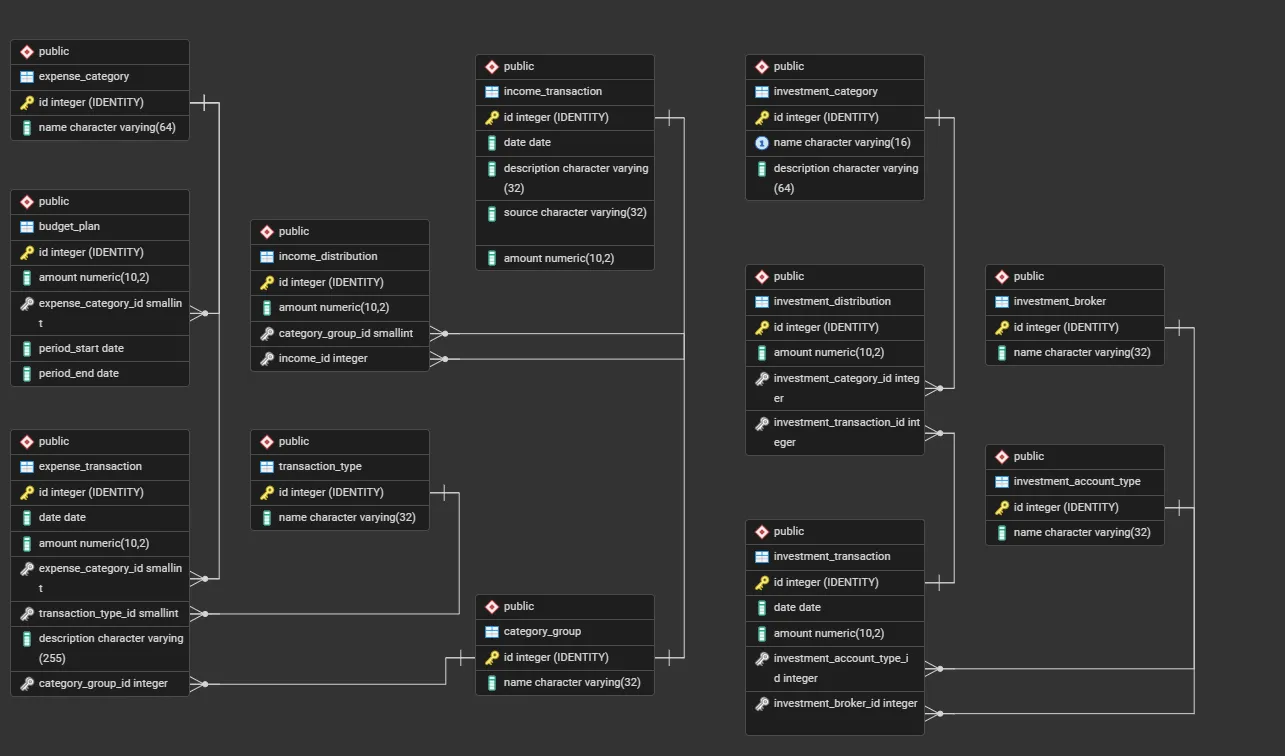
The database has two (2) independent groups: cash flow, and investments. For cashflow, I have tables for income/expense transaction, income distribution, budget plan, category, category group, and transaction type. While investments has transaction, distribution, broker, category, and account type. I designed the database based on the data that I needed. Tables might be updated or added, depending on my current needs. For now, I just needed to know the following:
- Monthly/Annual Income & Expense
- Income Distribution
- Income vs. Expense
- Budget Plan
- Investment Transaction & Distribution
- Available Cash to Spend
- Total Net Worth
I like keeping things simple so I try not to overengineer the database.
Technology Stack
Languages:
Backend:
Infrastructure:
Data:
I chose Go for the backend since it is fast and simple. For infrastructure, I use Docker and Docker Compose to start individual services easier, especially since the application is self-hosted. Air provides live reloading during development, while Makefile is used to aggregate commands for running, stopping, and viewing logs from docker containers. Grafana and PostgreSQL are already explained in the above sections.
What’s next?
This project is currently on hold since I am too busy with my website aivertex, working at KFC, and studying for an SC-200 certification. I’ll try to make the system easy to setup for self-hosting in the future.